Your browser cannot start the WebGL instrument. The complete text atlas remains available below.
Drag horizontally, use the mouse wheel while the scene has focus, or press left and right arrow keys to move through cosmic scale. Press Space to play or pause the guided ascent. Press Home or End to jump to the first or final landmark.
Living Universe Engine · WebGL2
Fly through the architecture of scale.
Not a video and not a stack of static cards. Every world, star, horizon, nebula and galaxy is placed on a continuous logarithmic journey driven by the same physical measurements as the atlas.
Drag · wheel · arrow keys · space to play
Render
ORDER OF MAGNITUDE104 m
Adaptive scoreThe Vast Between
The complete scale · 121 landmarks
Everything fits on one line. Nothing fits in one intuition.
From Planck length to the observable universe, Vastoscope spans more than sixty-one orders of magnitude.
A cinematic view without pretending scale is simple.
The theatre uses logarithmic compression for continuity. “Local linear scale” restores linear size relationships among nearby landmarks, while the scientific entries retain each measurement definition and uncertainty class.
01
Scale-first ordering
Black-hole horizons can appear between moons and planets because the sequence follows measured extent, not familiar taxonomy.
02
Representation changes
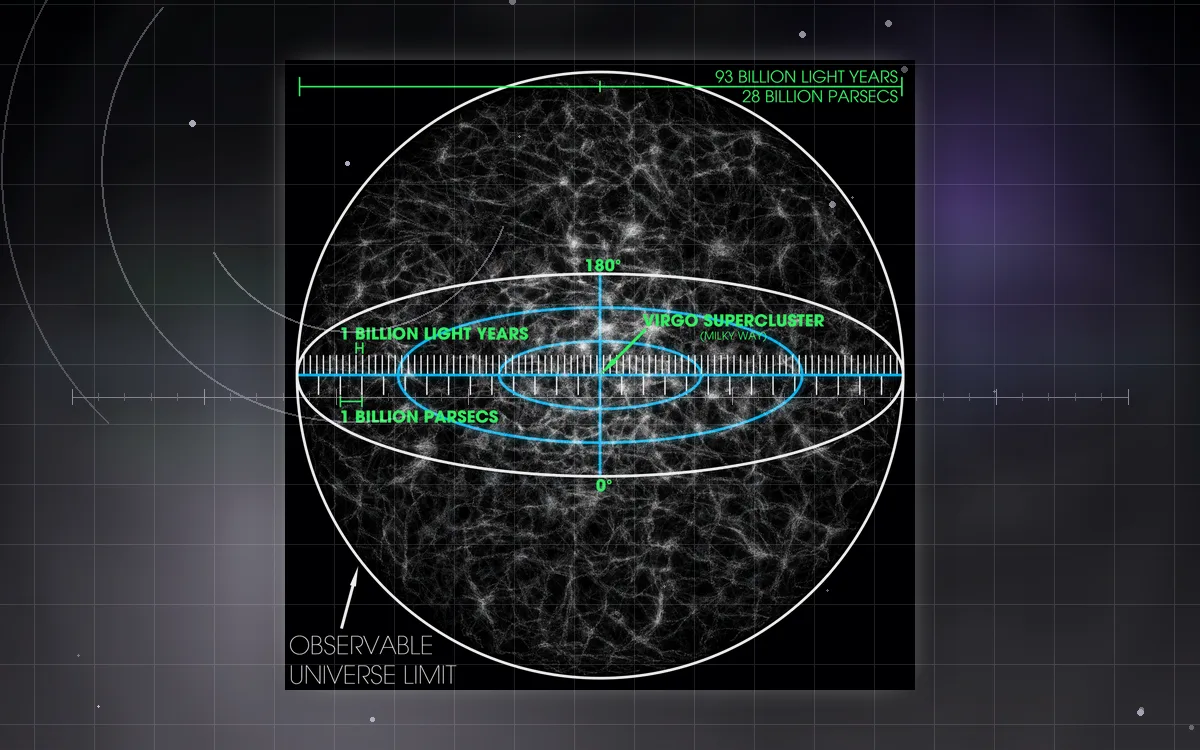
Worlds use illuminated evidence textures, stars use turbulent procedural light, black holes use lensing-inspired shaders, and the cosmic web becomes a field rather than another sphere.
03
One portable shader language
The renderer uses GLSL ES 3.00 with small, explicit programs that map directly to desktop OpenGL shaders without an external engine.
Server-rendered cosmic index
Every landmark remains readable without WebGL.
The visual flight is progressive enhancement. The permanent object pages, measurements, sources and links below remain crawlable and accessible when graphics or JavaScript are unavailable.